Pronunciation
Hear yourself next to a native speaker.
Record a word. Both takes play lined up, and the sounds that drifted are marked.
Reading a word and saying it are different skills, and only one of them gets practice while you read. Pronunciation closes that gap with the comparison a teacher would give you.
Included with Pro · See plans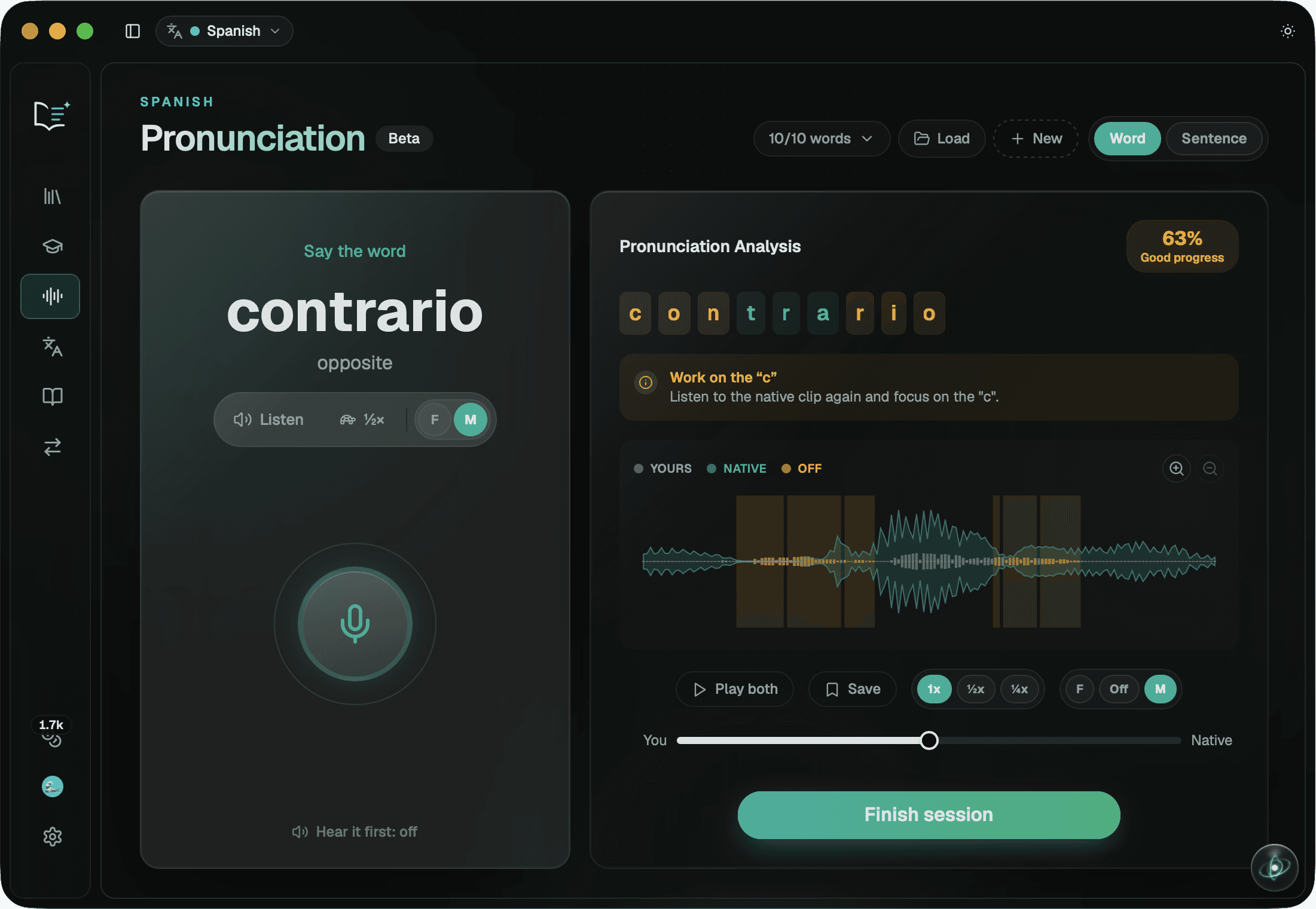
How it goes
Listen, say it, look at what happened.
Ten words a session, taken from the words you saved while reading rather than a stock list.
It plays first
The native recording plays the moment the word appears. Slow it down if you need it.
You say it
Tap once and speak. Recording stops on its own when you stop talking.
You see it
Your waveform against the native one, with each sound scored separately.
Sound by sound
Which sound, not just which word.
Every letter gets its own score, and the ones that came through cleanly are separated from the ones that did not. Tap any sound to drill it on its own.
Problem bands on the waveform
The stretches that scored low are marked in amber, right where they happened in the audio.
One sound at a time
Tap a letter to isolate it: the word redraws with that sound lit, and you get five reps of native, yours, or both.
Plain notes, not phonetics
B and V are the same sound in Spanish. Never bite your lip, both are made with the lips together.
Your take, warped onto theirs
Aligned playback stretches your recording onto the native speaker's syllables so the two run together instead of one after the other.
The comparison
Fade from your voice to theirs, mid-word.
A slider moves between the two recordings while they play, at full, half or quarter speed. Hearing the swap happen inside a single word is what makes the difference obvious.
Over a session
The sound you keep missing.
Individual words are noise. The pattern across ten of them is the thing worth practising, so the summary groups every sound you made into families and ranks them worst first.
When a word cannot be scored, the summary says so rather than quietly leaving it out.
Languages
Nine languages.
Spanish, French, Italian, Portuguese, German, Korean, Japanese, Mandarin and Esperanto, each one built against how that language actually sounds rather than ported over from the last. Esperanto is scored on your own device, against the app's Esperanto voices.
With Coach
Coach works your mouth into the week.
Speaking is a short specialist track, about four minutes, and it takes turns with the other short tracks across the week rather than landing on every day and crowding it. Tell Coach you want more of it and it moves into every day instead.
How Coach builds your weekA 20 minute Thursday
- Flashcards3 min
- Basics8 min
- Pronunciation4 min
- Verbs6 min
Built into a plan in the eight languages pronunciation can be scored in.
What a score means
The comparison is the feature.
The scores catch clear errors and miss subtle ones, and they are a hint that points your ear somewhere. What actually teaches pronunciation is hearing yourself against a native speaker, which is why the playback sits at the centre of the screen and the number sits in the corner.
Pronunciation is in beta and desktop only, since it needs a microphone.
Say it out loud, for once.
Pronunciation is part of Lexxio, alongside the reader, the dictionary and Coach.
Be first through the door.
Join the waitlist and we'll email you the moment Lexxio is ready to read. Anticipated late Fall 2026.