Flashcards
The deck builds itself.
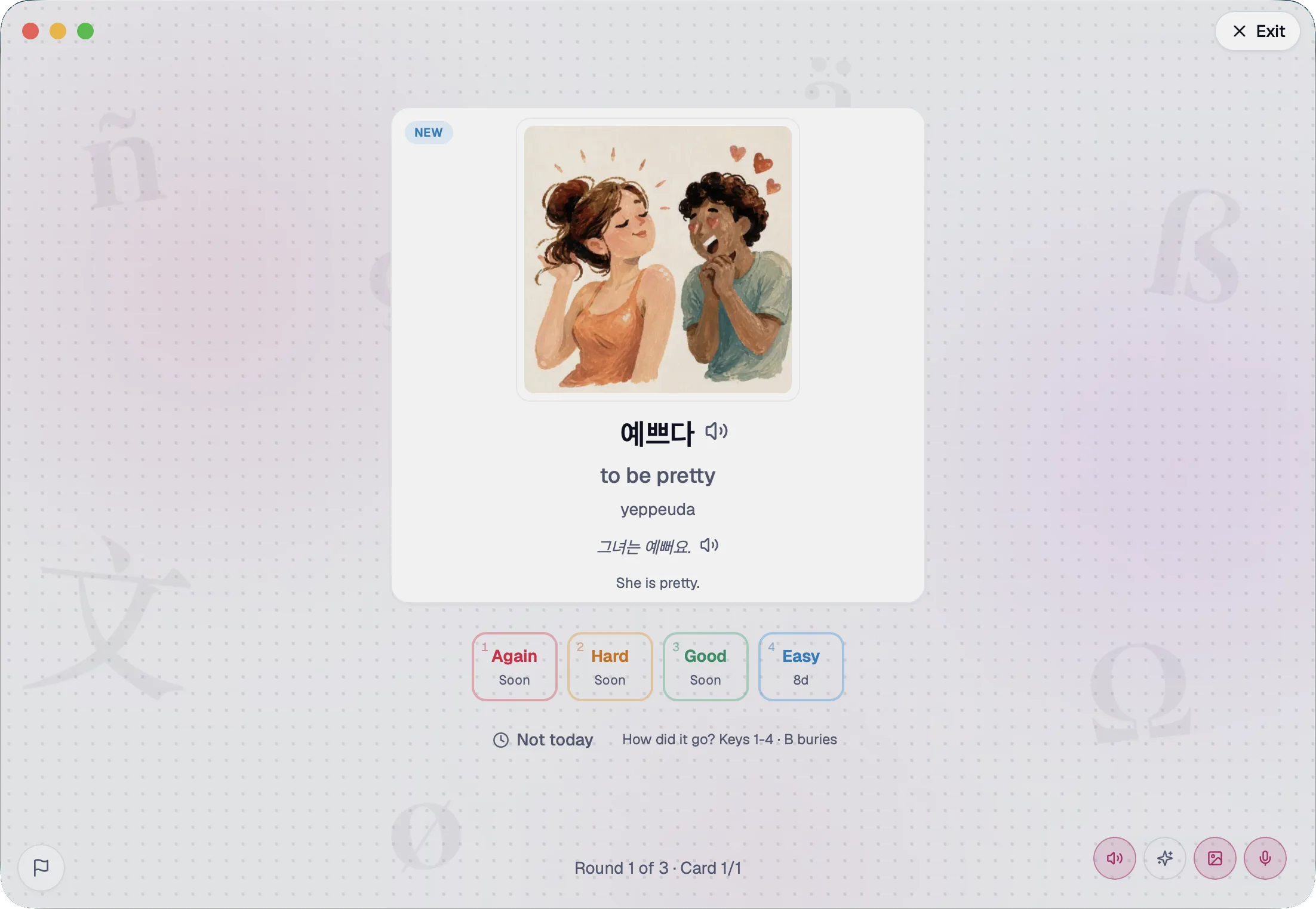
Every serious flashcard app asks you to make the cards. That is the part that kills the habit. Here, a card is one tap on a word you just met, and it arrives with the meaning, the pronunciation, and the sentence you found it in already on the back.
The deck-building tax
Nobody quits because the algorithm was wrong.
They quit because it is 9pm and there are forty words in a notes app waiting to be turned into cards. Making cards is unpaid work, and it is the only reason most decks die.
What making a card usually costs
Find the word again. Look it up. Copy the definition. Find a sentence that uses it. Get the pronunciation. Pick a note type. Paste it into four fields. Repeat, for every word, forever.
What it costs here
One tap, while you are still looking at the word. The card is made from the lookup you already did, in the book you were already reading.
Where cards come from
A card is a word you actually met.
Nothing is dealt to you off a stranger's list. Every card is either a word you met in a real sentence and kept, or one a Basics lesson has just taught you.
From the page you were on
Tap a word while reading and it is saved with its meaning, its pronunciation, and the sentence it appeared in. That sentence is not decoration on the back of the card: it comes back later as the card itself, with the word taken out of it.
From a Basics lesson
Every word a Basics lesson teaches joins the deck the moment it is taught, carrying a sentence from that unit's story as its example. Whether the lesson went well is not the scheduler's business. Function words are left out on purpose.
From a lookup
Anything you look up in the offline dictionary can be kept, whether or not it came out of a book.
From a character
Chinese, Japanese, and Korean characters save as their own card type, prompting for the reading rather than the meaning, because those are different things to know.
Or type a handful, right now
Quick cards take a few words typed straight in, fill the backs from the offline dictionary, and run a one-off loop. Nothing is saved, nothing enters the schedule.
The scheduler
It comes back the day before you would have forgotten.
You do not have to think about any of this. Cards arrive when they are about to slip, the ones you know get out of the way, and the ones that keep beating you get pulled out rather than left to eat your sessions.
The gaps stretch as a word sticks
A word you recall easily comes back in a week, then a month, then a year. One you keep missing comes back tomorrow. You never set a single interval yourself.
Four grades, and what each one buys
Again, Hard, Good, Easy, on keys 1 to 4, each showing the date it would move the card to before you commit. No guessing at what a button does.
The cards that fight you get caught
A word that keeps lapsing is pulled out and shown to you, instead of quietly taking a slice of every session for the next year. Usually the card is the problem, and now you can see it.
Underneath it is FSRS, the same open-source scheduler Anki uses, with an optimizer that trains on your own history on your own device. Every knob is yours if you want it.
How the scheduler worksThe session
A round at a time, and a way out.
Sessions run for a set number of rounds or a set number of minutes, and you choose what they are made of.
Pick what the session is for
Four ways to be asked
Recognize it
The word on the front, the meaning on the back. Where every card starts.
Produce it
Once a card is mature it starts coming the other way round, meaning first, so you have to make the word rather than just know it.
Fill it back in
A word you saved while reading comes back inside the sentence you met it in, with the word itself taken out. Early on you pick from four; later the options come away and you type it. No other app can do this, because no other app knows which sentence was yours.
Say it back
On mature cards in the languages we can score, the card asks you to say the word out loud and listens. You get a score and a hint on what to move, with a few tries before it lets you past.
Cards can speak themselves, on arrival for a prompt or on the flip for an answer, so a word is never only a shape on a screen.
Where a word has a picture, the card leads with it, and can hide the word entirely so the meaning arrives before the spelling does.
A speak card, start to finish

Try 1 of 3
Skip this oneThe honest part
Sometimes it tells you not to review.
When enough of the words due today sit inside one chapter you have not read, the app says so, by name, and offers you the chapter instead. Fifteen minutes of a story beats fifteen minutes of the same fifteen words in a stack, and a flashcard app that will not admit that is selling you the stack.
Chapter 4 of Apartment 307 contains 12 of the words you are due to review.
Bring your deck
Both doors are open.
Migration is a promise you make once and honor in both directions, or it is not a promise.
Import an .apkg, schedule and all
Your cards arrive where you left them: due dates, intervals, repetitions, lapses, suspended cards, and the review history behind them. Nothing resets to new, and nothing you already have is overwritten.
Export an .apkg, history and all
Take the deck back out whenever you want, with the review log attached, and open it in Anki. There is no version of this where your years of reviews are stuck inside our app.
With Coach
Coach opens the day with the cards that are due.
Review leads a guided day whenever anything is waiting, which is what stops it being the thing that gets dropped when the day runs long. Coach hands the session its own time budget and focus and it starts itself, with no setup sheet in the way.
How Coach builds your weekA 15 minute Tuesday
- Flashcards3 min
- Basics8 min
- Verbs6 min
Ask for more review and flashcards take a bigger share of the opening block.
The cards were never the point.
Reading is. But the words you meet once are gone by Thursday, and that is what this is for: a deck that costs nothing to build, run by a scheduler that does not treat you like a beginner, pointing you back at the book as soon as it can.
Be first through the door.
Join the waitlist and we'll email you the moment Lexxio is ready to read. Anticipated late Fall 2026.